
5 Components of The Science of Happiness at Work (tm) system for High Performance Organisations
Workplace productivity is always top of mind for smart managers and business leaders. So any ability to improve workplace Culture, Climate, context and consciousness it valuable.
Recent robust research by iOpener UK into staff happiness identified five important components that inform and build greater levels of employee engagement and Happiness at Work.
They matter because they facilitate a shift in mindset and performance, and a host of other personal and organizational benefits that go beyond improved engagement and satisfaction.
That's why it's so important that everyone take action to build a high performance teams workplace
- Contribution is the effort an individual or team makes.
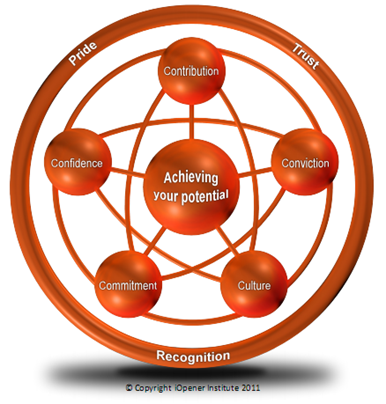
- Conviction is your short-term motivation in both good times and bad.
- Culture is the extent to which you feel you fit at work.
- Commitment is your long-term motivation.
- Confidence is your belief in your own abilities at work.
These 5Cs act as a business style ecosystem: when one starts to become affected, the others will become unstable in turn.
And that means staff performance will quickly drop off. But when everyone has high levels of all the 5Cs, then they'll perform at their best whatever happens.
Pride, Trust and Recognition
The 5 Cs are supported by Pride, Trust, and Recognition.
They correlate with each driver of happiness and are fundamental building blocks of any successful organization.
- Pride in your organization comes from identifying with it, knowing who your work affects, and being aware of its wider impact.
- Trust in your organization flows from two sources; your colleagues and your senior leaders.
- Recognition for your achievements comes from who you are, what you do, how you work, and how dedicated you are. It is about more than just money. It is about being recognized in the way you most prefer.
It has been found that Pride and Trust generally go together.
If you're proud of where you work, you'll also trust your workplace and its leaders.
Recognition works differently:
This is about having personal effort noted and appreciated.
For business leadership talks, tools, tips. coaching, staff high performance team building events and consulting contact Tony Dovale on Tel:083-447-6300
www.lifemasters.co.za
v2026.3.15aAD
FAQ
Q1: What are the 5Cs of the Science of Happiness at Work™?
A1: The 5Cs are Contribution, Conviction, Culture, Commitment, and Confidence. Together, they form a workplace ecosystem. When these five elements are high, employees are more resilient, productive, and engaged, even during periods of organizational change.
Q2: How does the 5Cs framework improve business ROI?
A2: Research shows that happy employees are up to 25% more productive. By focusing on the 5Cs, organizations reduce the "Silence Tax" and absenteeism while increasing retention and innovation. It transforms the workplace from a "compliance" culture to a "high-performance" culture.
Q3: What role do Pride, Trust, and Recognition play in this system?
A3: Pride, Trust, and Recognition are the fundamental building blocks that support the 5Cs. Pride and Trust usually grow together; if a team trusts their leaders, they take pride in their brand. Recognition ensures personal effort is valued, fueling long-term motivation and commitment.
Q4: Can the 5Cs be measured within a South African corporate context?
A4: Yes. Life Masters provides specialized HPO (High Performance Organization) assessments and mindset checkups designed to measure these specific drivers within your team, allowing for data-driven interventions in Johannesburg and across South Africa.
Q5: How does this link to the Revolutionary Workplace and AdaptAgility?
A5: The Science of Happiness is a core pillar of the Revolutionary Workplace philosophy. By mastering the 5Cs, leaders build the "Psychological Capital" necessary for AdaptAgility—the ability for a team to pivot quickly and remain resilient in a volatile market.